


Wondering exactly how big a Coke can is? A standard 12 oz can stands about 4.83 inches tall and 2.6 inches wide, holding 355 ml of soda. That’s the number most people search for. But Coca-Cola sells cans in way more shapes and sizes than that, from tiny mini cans to tall slim ones, and each format has its own set of measurements.
This guide breaks down every Coke can size you’ll find on shelves, why the numbers are what they are, and where those dimensions actually matter in real life. Grab a drink and let’s get into it.
Quick Reference: Standard 12 oz Coke Can
The standard 12 oz Coke can is the one you grab from a vending machine or a six-pack in the fridge. It’s the most recognized beverage can shape in the world, and honestly, most people never think twice about its exact size.
Here’s what you’re working with on the classic standard can:
- Height: 4.83 inches (12.3 cm)
- Body diameter: 2.6 inches (6.6 cm)
- Lid diameter: 2.06 inches (5.2 cm)
- Volume: 12 fluid ounces (355 ml)
- Empty weight: around 0.5 oz (14.9 grams)
- Full weight: around 12.8 oz (368 grams)
These numbers aren’t random. They come from decades of can engineering that balances material cost, shelf space, and how the can feels in your hand. We’ll get into that shortly.
Every Coke Can Size: Full Dimensions Chart
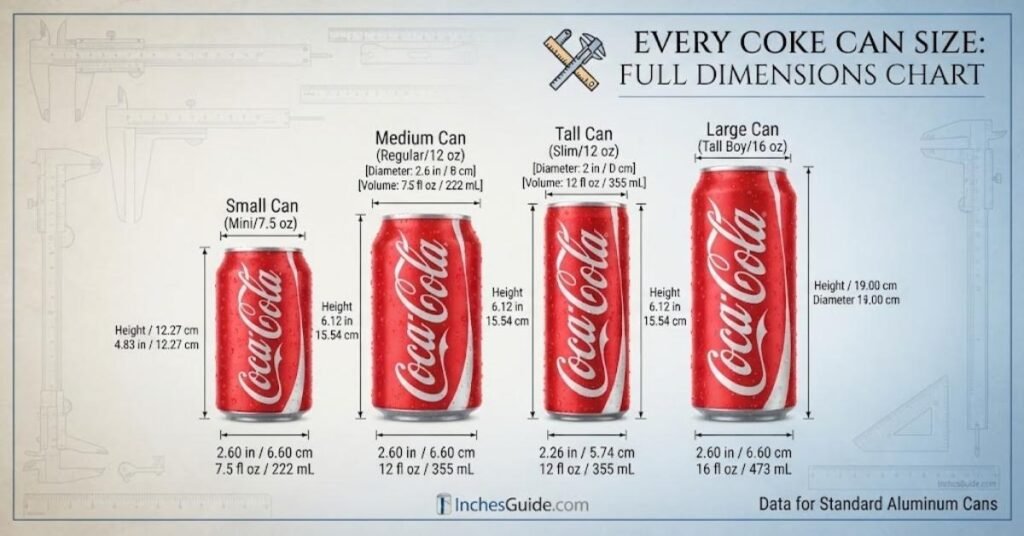
Coca-Cola doesn’t just make one size. Depending on where you live and what you’re buying, you might run into a mini Coke can, a slim can, a tallboy can, or something in between. Each one is built for a different moment, whether that’s portion control, a party cooler, or a premium look on a store shelf.
Here’s a full Coke can size chart covering the common formats you’ll actually find:
| Format | Volume | Height | Diameter |
|---|---|---|---|
| Mini can | 7.5 oz (222 ml) | 3.75 in (9.5 cm) | 2.13 in (5.4 cm) |
| Standard can | 12 oz (355 ml) | 4.83 in (12.3 cm) | 2.6 in (6.6 cm) |
| Slim/sleek can | 7.5 oz (222 ml) | 5.31 in (13.5 cm) | 2.13 in (5.4 cm) |
| Euro standard can | 330 ml | 4.83 in (12.3 cm) | 2.6 in (6.6 cm) |
| Australian can | 375 ml | 5.31 in (13.5 cm) | 2.6 in (6.6 cm) |
| Tallboy can | 16 oz (473 ml) | 6.19 in (15.7 cm) | 2.6 in (6.6 cm) |
| Large can | 20 oz (591 ml) | 6.9 in (17.5 cm) | 2.6 in (6.6 cm) |
Notice how the body diameter often stays the same across formats while the height changes? That’s intentional. It lets manufacturers reuse the same production lines and the same can body tooling, which keeps production cost down even when they’re offering different volumes.
What Makes the Standard Can This Specific Size
Ever wonder why 12 oz became the magic number? It wasn’t picked out of thin air. Back in the mid-1900s, beverage companies were switching from glass bottle packaging to aluminum packaging, and they needed a size that felt substantial but wasn’t wasteful.
The cylinder shape itself is a big part of the story. A cylinder gives you the most volume for the least amount of aluminum alloy, which matters a lot when you’re producing billions of units a year. Round shapes also handle internal pressure from carbon dioxide (CO2) far better than square or rectangular containers would.
There’s also a human factor here. The standard 12 oz Coke can fits comfortably in an average adult hand, which sounds small but matters more than you’d think for consumer convenience. Combine that with the material efficiency of the cylinder, and you get a shape that’s stuck around for over half a century without much change.
The 202 End: Why the Lid Is Narrower Than the Can
Take a close look at a Coke can and you’ll notice the top is narrower than the body. That’s not a mistake. It’s called necking, and the resulting lid size is known in the industry as the 202 end.
The name comes from old canning terminology, where the first digit refers to whole inches and the second two digits refer to sixteenths of an inch. A 202 end measures roughly 2.125 inches across, noticeably smaller than the 2.6 inch body diameter.
So why bother making the can lid smaller than the can body? Two reasons, mainly. First, the lid is usually made from a thicker, more expensive 5182-series aluminum alloy because it needs to hold up under pressure and support the pull-tab mechanism. Shrinking the lid diameter cuts down on how much of that pricier metal gets used. Second, a narrower top adds structural rigidity, helping the can resist denting during shipping and stacking. It’s a small design choice that saves manufacturers a surprising amount of money across billions of cans.
Coke Can Dimensions in CM: International Variations Explained
If you’ve traveled and grabbed a Coke abroad, you might’ve noticed the can felt a little different in your hand. That’s because Coke can dimensions in cm vary slightly by region, largely due to differing metric measurements standards and market preferences.
In the USA, the standard can holds 355 ml, using imperial measurements as the baseline (12 fl oz). Across Europe, the Euro standard can typically holds 330 ml, a touch smaller in volume even though the can height is nearly identical. In Australia, Coca-Cola often uses a 375 ml can, which is taller than both the US and European versions.
These aren’t just random regional quirks. They reflect local packaging standards, historical bottling agreements, and how each global market prices beverages. A 330 ml can in Europe might cost about the same as a 355 ml can in North America, simply because of how volume based pricing works in each region. If you’re comparing Coke can dimensions in cm across countries, always check the printed volume first, since a can that looks the same size might hold a different amount.
Coke Can Circumference and What It’s Actually Used For
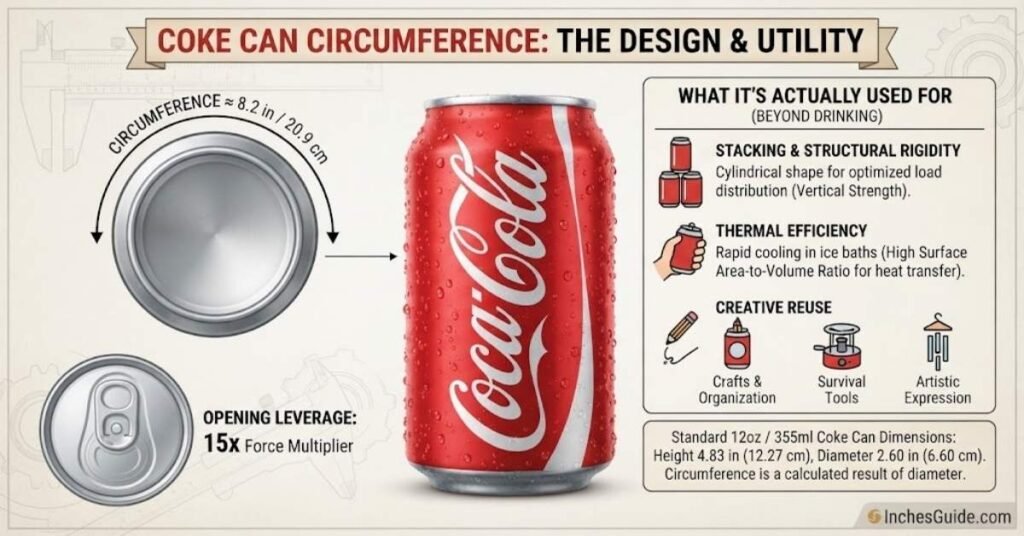
Here’s a detail most people never think about: the Coke can circumference. On a standard can, that comes out to roughly 8.2 inches (20.8 cm), calculated from the body diameter and radius using basic cylinder shape math.
Why does this number matter to anyone outside a factory? A few reasons, actually. Custom can wrap designers need the exact circumference to make sure a printed wrap or label design lines up perfectly around the can without stretching or overlapping oddly. Get the measurement wrong by even a few millimeters, and a promotional campaign wrap can look crooked on shelves.
Beyond branding, circumference also affects how cans behave in vending machine slots and automated packing lines. Machines are calibrated to grip and rotate cans based on that exact measurement, so even small manufacturing shifts can cause jams. It’s one of those hidden numbers that keeps the whole supply chain running smoothly without you ever noticing it.
Small Coke Can Dimensions: The Mini and Slim Formats
Not everyone wants a full 12 oz soda, and Coca-Cola figured that out a while back. That’s where the mini Coke can and the slim Coke can come in, both aimed at calorie-conscious consumers who want a smaller portion size without giving up the drink entirely.
The mini can holds 7.5 oz (222 ml) and stands about 3.75 inches tall with a 2.13 inch diameter. It’s short, stocky, and often shows up in multipacks marketed around portion control. The slim can, sometimes called a sleek can, holds the same 7.5 oz volume but stretches taller and narrower, standing around 5.31 inches with that same 2.13 inch diameter.
Why make two different shapes for the same volume? It comes down to positioning. The mini can feels casual and convenient, great for lunchboxes or quick snacks. The slim can, on the other hand, has a premium look that’s become popular with health-focused packaging trends, similar to what you’d see with energy drinks like Celsius or certain wellness drinks. Same soda, very different vibe, just from tweaking the height and diameter.
Does a Coke Can Fit in a Standard Cup Holder?
This one comes up more than you’d expect. Yes, a standard can fits comfortably into almost every automotive cup holder made in the last twenty years. Car manufacturers actually design vehicle cup holder dimensions around common beverage container sizes, and the 2.6 inch body diameter of a Coke can sits right in that sweet spot.
Most modern cup holders include rubber inserts or adjustable tension clips that flex slightly to grip cans of different grip profile widths. That’s how the same cup holder can snugly hold a slim mini can, a standard can, and sometimes even a wider disposable coffee cup. If you’ve ever noticed your soda wobbling in an older car, it’s likely because that vehicle was designed before cup holder compatibility became a standardized feature across the auto industry.
Larger formats like the tallboy can or large Coke can can be trickier though. Their height sometimes clears the cup holder’s depth, and if the vehicle has a low console lid above the holder, a tall can might not fit at all. Worth checking before you buy a tallboy for a road trip.
Refrigerator and Cooler Storage
Ever wonder why cans stack so neatly in a cooler or on a refrigerator shelf? That’s not luck. It comes down to the same cylinder shape that makes cans efficient to manufacture also making them efficient to store.
Round cans naturally settle into a pattern called hexagonal close-packing, which is more space efficient than lining them up in strict rows. That’s part of why a cooler storage setup can hold more cans than you’d guess just by eyeballing the box. Some manufacturers and retailers still use square packing for retail displays, mainly because it looks tidier and easier to restock, even though it wastes a bit of surface area compared to close packing.
For home storage, a mini fridge or dorm room cooler benefits the most from understanding these packing patterns. Arranging standard can rows in a honeycomb style instead of straight columns can genuinely fit a few extra cans into the same shelf space. It’s a small trick, but it works.
Coke vs Other Beverage Cans: Size Comparison
How does a Coke can stack up against other drinks on the shelf? For the most part, soft drink brands including Pepsi stick to nearly identical standard beverage can dimensions, which makes sense since they’re all built for the same retail shelving and vending machine infrastructure.
Where things get interesting is with energy drinks. Brands like Red Bull famously use a taller, narrower can that looks nothing like a Coke can, partly to stand out visually and partly because their smaller volume (usually 8.4 oz) doesn’t need the wider body diameter. Monster Energy, on the other hand, often uses a wider can closer to soda proportions, just taller to fit its larger volume.
Here’s a quick beverage can comparison for context:
- Coca-Cola standard can: 12 oz, wide cylindrical shape
- Diet Coke: same dimensions as regular Coke, just different label design
- Red Bull: 8.4 oz, tall and narrow
- Monster Energy: 16 oz, wide and tall
- Pepsi standard can: 12 oz, nearly identical to Coke’s dimensions
This kind of size comparison shows how much branding influences shape, even when the underlying can engineering goals stay the same across every company.
How Manufacturing Tolerances Affect Every Can You Buy
Even with all this precision, no two cans are perfectly identical. Manufacturing tolerances allow for tiny variations, usually within a fraction of a millimeter, in height, diameter, and wall thickness. These small gaps are expected and built into the production process on purpose.
Why allow any wiggle room at all? Because aluminum stretches and compresses slightly during forming, and demanding zero variation would slow down manufacturing and drive up production cost dramatically. Instead, engineers set an acceptable range, and as long as a can falls within it, it moves down the line without a second look.
These tolerances matter more than you’d think for packaging logistics. Pallets are stacked based on expected dimensions, and if too many cans drift toward the outer edge of tolerance, it can throw off how tightly a shipment packs, affecting everything from worldwide distribution timelines to retail infrastructure planning.
Coke Can Weight: Empty vs Full
People rarely think about how much a can actually weighs, but it’s a bigger deal in logistics than you’d guess. An empty standard can weighs around 14.9 grams (0.5 oz), thanks to how thin modern wall thickness has become compared to cans from the 1970s.
Once filled, that same can jumps to roughly 368 grams (12.8 oz), almost entirely from the liquid itself. This static weight difference matters a lot when you’re shipping millions of units. Lighter empty cans mean less aluminum alloy used per unit, lower shipping costs, and a smaller environmental footprint across the whole beverage industry.
Interestingly, can walls have gotten about 30% thinner over the past few decades without sacrificing structural rigidity. That’s thanks to better 3004-series alloy formulations and tighter engineering on how the metal is shaped during production. Thinner walls, same strength, lower cost. That’s the quiet innovation happening behind every can you crack open.
Frequently Asked Questions
How tall is a standard Coke can?
A standard 12 oz Coke can stands 4.83 inches (12.3 cm) tall, measured from the bottom of the can body to the top of the lid.
What is the diameter of a Coke can?
The body diameter measures 2.6 inches (6.6 cm), while the lid diameter, or 202 end, measures a smaller 2.06 inches (5.2 cm).
How many ounces is a mini Coke can? A mini Coke can holds 7.5 fluid ounces, equal to 222 ml, making it a popular choice for portion size conscious drinkers.
Do all Coke cans have the same circumference?
No. Coke can circumference changes based on body diameter, so a mini can and a standard can have different circumferences even though they’re both cylindrical.
Why is the top of a Coke can narrower than the body?
This is called necking, and it produces the 202 end. It reduces how much expensive aluminum alloy is needed for the lid while adding extra structural rigidity to the whole can.
Is a Coke can size the same worldwide?
Not exactly. International variations exist, with the USA typically using 355 ml, Europe using 330 ml, and Australia often using 375 ml cans.

James Walker is a content writer and researcher with a passion for making everyday information simple, useful, and easy to understand. He enjoys researching measurements, dimensions, size comparisons, and interesting facts and turning them into clear, engaging content for readers.
Through his work at HipeDigest, James focuses on providing informative and reader-friendly articles that combine accuracy, simplicity, and practical examples. His goal is to help readers discover useful information while making every topic enjoyable and easy to explore.
