

A standard Pokémon card measures exactly 2.5 inches wide by 3.5 inches tall. That’s 63.5mm by 88.9mm, or 6.35cm by 8.89cm if you’re working in metric. Every card in a booster pack, every promo, every reprint since 1996 sticks to this same footprint. If you’ve ever wondered why your binder holds cards so neatly or why sleeves from three different brands all fit the same way, this number is the reason.
Below, we’ll break down every measurement that matters. Width, height, thickness, weight, pixel sizes for digital art, sleeve fit, and how these numbers help you catch a fake before you pay for one.
Quick Measurements for Pokémon Card
If you’re in a hurry, here’s the short version.
A regular Pokémon card size is 2.5in x 3.5in. In millimeters that’s 63.5 x 88.9. In centimeters it’s 6.35 x 8.89. The corner radius sits at 0.125 inches, which is about 3.175mm, giving the card that soft rounded edge instead of a sharp corner.
Thickness runs between 0.30mm and 0.32mm for a regular card. Holo and full-art cards tend to run a touch thicker, closer to 0.35mm, because of the extra foil layer pressed into the cardstock. Weight sits around 1.7 to 1.8 grams for a single card, which explains why a full 60 card deck feels lighter than most people expect.
The aspect ratio works out to roughly 5:7. That ratio isn’t random. It’s the same proportion used across most Western trading card games, which is why your Pokémon cards slide into the same sleeves as your Magic: The Gathering collection without any fuss.
Exact Pokémon Card Dimensions: The Full Breakdown
Let’s get specific, because “about 2.5 by 3.5 inches” isn’t good enough if you’re buying a printer or checking a card’s authenticity.
The official card dimensions are 2.5000 inches wide and 3.5000 inches tall, held to a manufacturing tolerance of roughly plus or minus 0.5mm. That tolerance exists because print runs happen at massive scale, and even factory-precise machines drift a hair over millions of cuts. A card that’s 1mm off from standard isn’t automatically fake. A card that’s 3mm or more off almost always is.
Corner radius deserves its own mention. Genuine cards use a 0.125 inch radius, cut with a die that’s replaced regularly to keep the curve consistent. Bootleg printers often use a sharper or uneven radius because they’re working from cheaper tooling, and that small detail is one of the easiest ways to spot trouble at a glance.
Here’s the full spread in one place.
| Measurement | Inches | Centimeters | Millimeters |
|---|---|---|---|
| Width | 2.5 in | 6.35 cm | 63.5 mm |
| Height | 3.5 in | 8.89 cm | 88.9 mm |
| Corner Radius | 0.125 in | 0.3175 cm | 3.175 mm |
| Thickness (Standard) | ~0.012 in | ~0.03 cm | 0.30-0.32 mm |
| Thickness (Holo/Foil) | ~0.014 in | ~0.035 cm | up to 0.35 mm |
| Weight (Authentic) | — | — | 1.7-1.8 g |
Pokemon Card Dimensions in CM, MM, and Inches: All Formats
Different collectors think in different units, and honestly, that’s fine. American players default to inches. Most of Europe and Asia think in cm or mm. Here’s how the same card looks across every system you’ll actually run into.
In inches, you’re looking at 2.5 x 3.5. Switch to centimeters and it’s 6.35 x 8.89. Millimeters give you 63.5 x 88.9. And if you ever need feet for some reason (maybe you’re designing a giant wall display), that’s roughly 0.208ft by 0.292ft.
None of these numbers change based on where the card was printed or which set it came from. A standard card size stays locked whether you bought it at a US big box store or picked it up from a shop in Osaka. That consistency is baked into Pokémon Company standards, and it’s part of why the game has stayed collector-friendly for almost three decades.
Pokemon Cards Dimensions in Pixels and Digital Use
Anyone designing custom card art, building proxy cards, or making fan content needs pixel dimensions, not just physical ones. This is where resolution and DPI come into play.
Pokemon Cards Dimensions in Pixels by Resolution
At 300 DPI, which is the standard for commercial printing, a card canvas comes out to 750 x 1050 pixels. Bump that up to 600 DPI for archival printing or high-end reproduction work, and you’re at 1500 x 2100 pixels. That’s a huge file, so only go that high if print quality really demands it.
For web display and thumbnails, 150 DPI gives you 375 x 525 pixels, which looks sharp enough on most screens without bloating your file size. And for quick mockups or draft prints where quality doesn’t matter yet, 72 DPI at 180 x 252 pixels does the job fine.
| DPI | Width (px) | Height (px) | Best For |
|---|---|---|---|
| 72 | 180 | 252 | Mockups, drafts |
| 150 | 375 | 525 | Web display, thumbnails |
| 300 | 750 | 1050 | Print quality, commercial printing |
| 600 | 1500 | 2100 | Premium printing, archival printing |
Print Bleed Size
If you’re sending art to a print service, you can’t just design at exact card size. You need bleed area. Add about 0.125 inches to every edge, which brings your canvas size to roughly 2.75 x 3.75 inches, or 825 x 1125 pixels at 300 DPI. This extra margin gets trimmed off during cutting, so any background color or artwork that touches the edge won’t leave a thin white border on the finished card.
Keep your important text and artwork inside a safe zone, about 0.125 inches in from the trim line. Anything closer to the edge risks getting clipped if the cut shifts even slightly.
Pokemon Card Dimensions for Procreate
If you’re working in Procreate, set your canvas to 2.75 x 3.75 inches at 300 DPI, which lands you at 825 x 1125 pixels. Use the CMYK color profile if the final piece is heading to a physical printer, since colors shift between screen and paper. Stick with RGB color profile if the art is staying digital.
One thing to watch for: Procreate has layer limitations depending on your canvas resolution and your device’s memory. A 300 DPI card canvas is small enough that this rarely becomes an issue, but if you’re stacking dozens of detail layers on an older iPad, keep an eye on your available layer count.
All Pokémon Card Sizes: Standard, Jumbo, and Variants
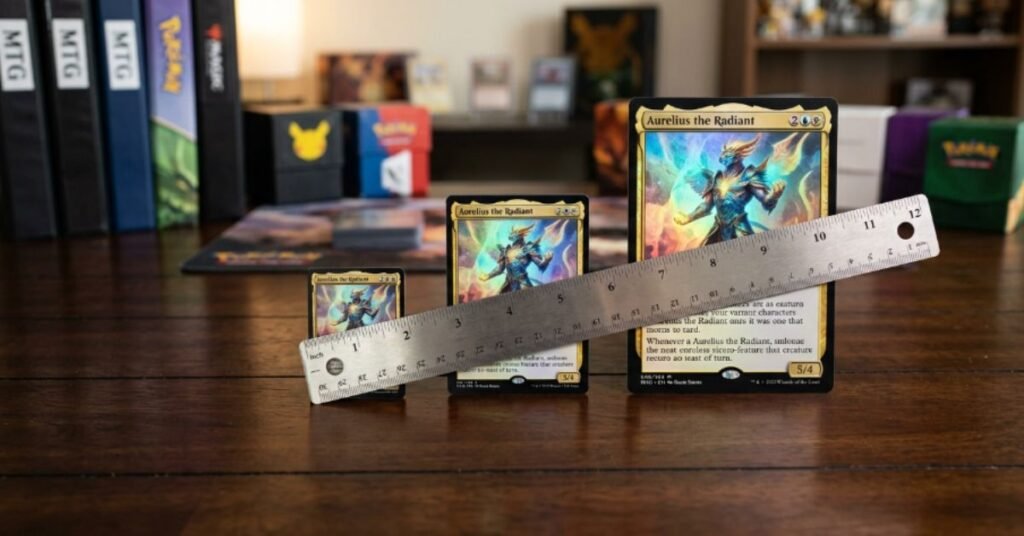
Not every Pokémon card follows the same size. Collectors who’ve only ever pulled cards from booster packs sometimes get a shock the first time they see a jumbo promo in person.
Standard Card
The standard Pokémon card measures 2.5 x 3.5 inches and covers roughly 99% of everything you’ll ever pull, buy, or trade. Every set since the game launched in 1996 uses this size, from base set commons to modern full-art cards.
All Pokémon Card Size Variants
Jumbo cards break the mold, and they’ve changed size more than once over the years.
Older Jumbo (Pre-2020) promos, common during the WotC era, measured around 6.0 x 8.0 inches. Jumbo XL cards from before 2019 sat at 5.7 x 7.87 inches. Modern Jumbo (Post-2020) cards were redesigned smaller, closer to 5.37 x 7.37 inches, mainly so collectors could fit them into updated binder pages.
Box Topper cards, the oversized promos tucked into booster boxes, run around 3.54 x 4.96 inches. And special releases like CoroCoro XXL promos or Topps Mega Chrome style cards push even bigger, though exact sizes vary by release since these aren’t standardized the way regular cards are.
| Card Type | Width | Height | Notes |
|---|---|---|---|
| Standard | 2.5 in | 3.5 in | All sets since 1996 |
| Box Topper | 3.54 in | 4.96 in | Modern box inserts |
| Jumbo XL (Pre-2019) | 5.7 in | 7.87 in | Older retail promos |
| Jumbo (Pre-2020) | 6.0 in | 8.0 in | WotC era |
| Jumbo (Post-2020) | 5.37 in | 7.37 in | Redesigned for newer binders |
How Big Is a Pokémon Card Really? Visual Comparisons
Numbers on a chart only tell you so much. Sometimes you need a real-world object to picture the size against.
A Standard Credit Card
A credit card is close, but not identical. Credit cards run about 3.37 x 2.125 inches, so a Pokémon card is noticeably taller and a bit narrower. Lay one on top of the other and the difference jumps out immediately.
A US Dollar Bill
A US dollar bill measures 2.61 x 6.14 inches. Compare that to your Pokémon card and you’ll notice the bill is close in width but nearly twice as long. Not exactly a twin, but the width match is close enough that people sometimes reach for a dollar bill as a rough size reference when they don’t have a ruler handy.
A Standard Smartphone
Most modern smartphones run wider and shorter than a Pokémon card, roughly 2.8 x 5.8 inches for an average device. Hold your card next to your phone and you’ll see the card is narrower but noticeably shorter overall, since phone screens have stretched taller over the years.
A Playing Card
This is the closest match you’ll find. Poker-size playing cards measure the exact same 2.5 x 3.5 inches. That’s not a coincidence. Pokémon adopted the same card format used across most Western games, which is precisely why generic sleeves fit both without any modification.
A Post-It Note
A standard Post-It note measures 3 x 3 inches, making it slightly wider but shorter than a Pokémon card. It’s a handy comparison if you’re trying to visualize scale without pulling out measuring tools, since Post-Its sit on nearly every desk.
Japanese vs International Pokémon Cards: Same Size
Here’s something that surprises newer collectors. Japanese Pokémon cards and English Pokémon cards share the exact same physical dimensions. Same 2.5 x 3.5 inches, same corner radius, same general footprint.
Where things differ slightly is thickness and cardstock feel. Japanese cards often use a thinner, snappier stock compared to the slightly stiffer feel of Western prints. Some collectors describe Japanese cards as having more “give” when you bend them gently, while international cards feel a touch more rigid.
This matters for storage. Japanese-size sleeves exist as a category, but that label refers to games like Yu-Gi-Oh! or certain Japanese card games with genuinely smaller card sizes, not to Japanese Pokémon cards specifically. Your Japanese Pokémon pulls will still fit into standard Pokémon sleeves without any issue.
Pokemon Card Dimensions for Sleeves and Storage
Getting sleeve dimensions right protects your collection from edge wear, fraying, and general handling damage over time.
Sleeve Sizes by Type
A standard outer sleeve typically measures around 2.625 x 3.625 inches, giving just enough room to slide a bare card in without it jamming. Perfect fit sleeves, sometimes called inner sleeves, run tighter at roughly 2.52 x 3.5 inches, hugging the card closely with almost no wiggle room.
Many serious collectors use double sleeving, which means a perfect fit inner sleeve goes on first, then a standard outer sleeve goes over that combo before the card heads into a toploader or binder. This layered approach cuts down on centering shift and keeps corners from rubbing against sleeve seams during shuffling.
Toploader Sizes
Toploaders come in different thickness ratings measured in points, not inches, since the card footprint stays the same. 35 PT fits a single sleeved card comfortably. 55 PT and 75 PT toploaders leave room for a card plus a penny sleeve, or even a couple of stacked cards for shipping protection. Internal capacity matters more than outer size here, since a loose fit lets cards shift and pick up scuffs during transport.
Pokemon Card vs Other Trading Cards
How does a Pokémon card stack up against other trading cards you might already own?
Magic: The Gathering cards match Pokémon exactly at 2.5 x 3.5 inches, which is why crossover collectors rarely need separate storage systems. Yu-Gi-Oh! and Cardfight Vanguard run smaller, closer to 2.34 x 3.42 inches, small enough that Pokémon sleeves won’t grip them properly. Baseball cards and other classic sports cards also share the 2.5 x 3.5 standard, which explains why vintage card shops stock one universal sleeve size for most of their inventory.
Playing cards split into two camps. Poker-size playing cards match Pokémon’s dimensions exactly, while bridge playing cards run narrower at around 2.25 x 3.5 inches, built that way so players can fan a full hand without struggling to hold it.
How to Spot Fake Pokémon Cards Using Dimensions
Counterfeit cards have gotten better over the years, but they still slip up on physical details that are hard to fake without factory-grade equipment.
Width and Height
Pull out a ruler and measure edge to edge. A genuine card sits at 2.5 x 3.5 inches within a tiny fraction of a millimeter. If your card measures notably off, even by 2 or 3mm, treat that as a warning sign worth investigating further.
Thickness
Card thickness is one of the toughest specs to fake convincingly. Authentic Pokémon cards use tri-layer cardstock with a graphite core sandwiched between two layers of white paper core. This construction gives the card a specific snap and rigidity that thin, single-layer counterfeits simply can’t replicate. If a card feels flimsy or bends too easily, that’s often your first clue.
Weight
A precision scale settles this quickly. Genuine cards weigh 1.7 to 1.8 grams. Fakes tend to run lighter because they skip the layered cardstock construction, or occasionally heavier if they’re using thick, cheap cardboard stock instead.
The Light Test
Hold the card up against a strong light source. Authentic cards have an opaque black layer inside that blocks light almost completely, thanks to that graphite core we mentioned earlier. If light shines through your card like it’s tracing paper, you’re very likely holding a fake.
Corner Radius
Check the curve of the corners under close inspection. Genuine cards keep a smooth, consistent 0.125 inch corner radius on all four corners. Counterfeit detection experts often point to uneven, sharp, or inconsistent corners as one of the fastest tells, since bootleg die-cutting tools rarely match factory precision.
How to Measure a Pokémon Card Without Calipers
Don’t own a digital caliper? You’ve still got options.
Most smartphones include a measurement app with a built-in ruler function that uses your camera to estimate length. It won’t be lab-grade accurate, but it’s close enough to flag an obviously miscut card. You can also lay the card against a printed ruler at home, lining up the edge precisely and reading the measurement at eye level to avoid parallax error.
For a rough sanity check, compare your card directly against a card you already know is authentic. Stack them corner to corner. Any size mismatch becomes obvious fast, even without a single measuring tool in sight.
Understanding Manufacturing Tolerances and Print Accuracy
Even legitimate cards aren’t cut with laser-perfect consistency every single time. Manufacturing tolerances allow for small, expected variance, usually within half a millimeter, across a massive print run. This is why professional grading services like PSA and BGS don’t reject a card just because it’s technically 0.3mm off standard. Instead, they look at centering analysis, corner sharpness, edge quality, and surface condition together to judge authenticity and grade.
A slightly miscut card that’s genuinely from a factory print run is different from a counterfeit built on entirely wrong tooling. Understanding this distinction helps collectors avoid two mistakes: panicking over a normal factory variance, or ignoring genuinely suspicious dimensional differences that point to a fake.
Why Card Dimensions Matter for Collectors and Players
Beyond authentication, exact physical dimensions shape everyday parts of the hobby. Shuffling a deck built entirely to spec feels smooth and consistent, while mixed sizes in a deck cause jamming and visible gaps during tabletop play. Binder pockets are cut to standard size, so a single oversized or undersized card throws off an otherwise tidy page. And when it’s time to sell, buyers often ask about condition and size together, since a card that doesn’t match standard dimension guide numbers raises immediate red flags in any authenticity check.
FAQs
What is the exact size of a Pokémon card? A standard Pokémon card measures 2.5 x 3.5 inches, or 63.5 x 88.9mm, or 6.35 x 8.89cm.
Are Japanese Pokémon cards a different size than English ones? No. Both use identical physical dimensions. The difference lies in cardstock feel, not size.
How thick is a real Pokémon card? Standard cards run 0.30 to 0.32mm thick. Holo and foil cards run slightly thicker, up to about 0.35mm.
What sleeve size fits a Pokémon card? Standard outer sleeves run about 2.625 x 3.625 inches. Perfect fit inner sleeves run tighter, closer to 2.52 x 3.5 inches.
How can I tell if a Pokémon card is fake using its size? Compare width, height, thickness, weight, and corner radius against known standard measurements. Multiple mismatches, especially in thickness or weight, are strong indicators of a counterfeit.
What resolution should I use for digital Pokémon card art? 300 DPI works for most print projects, giving you a 750 x 1050 pixel canvas. Go higher, to 600 DPI, only for premium or archival printing.
Final Thought
Card dimensions might seem like a small detail buried under bigger questions about rarity, value, or gameplay. But once you know the exact numbers, a lot of other things click into place. You’ll pick sleeves that actually fit. You’ll spot a counterfeit before you overpay. You’ll set up your digital canvas correctly on the first try instead of guessing. A Pokémon card has stayed 2.5 x 3.5 inches since 1996, and that consistency is quietly one of the reasons this hobby has stayed so accessible for almost thirty years.

James Walker is a content writer and researcher with a passion for making everyday information simple, useful, and easy to understand. He enjoys researching measurements, dimensions, size comparisons, and interesting facts and turning them into clear, engaging content for readers.
Through his work at HipeDigest, James focuses on providing informative and reader-friendly articles that combine accuracy, simplicity, and practical examples. His goal is to help readers discover useful information while making every topic enjoyable and easy to explore.
