


So you’ve got a number in front of you. 7 kg. Maybe it’s on a parcel label, a suitcase scale, or a dumbbell at the gym.
But numbers on their own don’t mean much. Your brain doesn’t “feel” kilograms.
That’s why this guide skips the boring math lecture. Instead, you’ll see 7 kilograms through things you already know, touch, and carry.
By the end, you’ll never have to guess what 7 kg feels like again.
7 kg, Translated Into Every Unit You’ll Actually Use
Let’s get the numbers out of the way first, since some of you landed here just for the weight conversion.
7 kg equals 15.43 pounds. If you want it broken down further, that’s 15 lb 6.9 oz in the imperial system.
In stone, it comes to roughly 1.10 stone. In pure metric terms, that’s 7,000 grams, or 0.007 tonnes if you’re dealing with shipping or freight numbers.
Here’s a quick conversion table so you don’t have to scroll back up every time:
| Unit | Value |
| Kilograms | 7 kg |
| Pounds (lb) | 15.43 lb |
| Pounds and ounces | 15 lb 6.9 oz |
| Stone | 1.10 stone |
| Grams | 7,000 g |
| Metric tonnes | 0.007 tonnes |
Keep this weight chart handy. You’ll need it again once we start comparing 7 kg to things sitting in your house right now.
Why You Keep Bumping Into 7 kg
Here’s the funny part. Once you start noticing 7 kg, it shows up everywhere.
Airlines use it as a cabin baggage limit. Gyms sell it as a starter dumbbell size. Even babies hit this weight around a certain age.
It’s not a random number. It sits in that sweet spot, heavy enough to challenge you, light enough to still carry with one arm for a short walk.
That’s exactly why a solid weight reference point like this one matters. You stop guessing and start knowing.
14 Everyday Things That Land Right on 7 kg
Reading a number is one thing. Picturing it in your hands is another.
Below are 14 everyday objects that either hit 7 kg exactly or land close enough that the difference won’t matter to you in real life.
Grab a coffee. Let’s go through them one by one.
A 7 kg Dumbbell
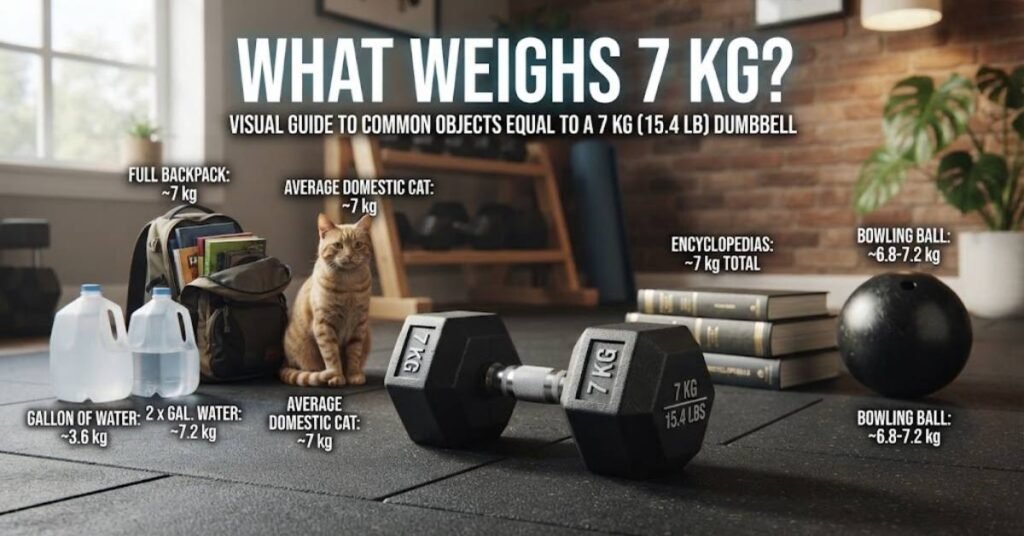
This one’s the most literal entry on the list, and honestly, the easiest way to feel the weight yourself.
A 7 kg dumbbell is a common size in most home gym setups. It’s heavier than beginner weights but still manageable for moves like lateral raises or bicep curls.
If you’ve never held one, walk into any gym and ask for the fixed weights rack. Pick up the 7 kg pair. That sensation in your forearm? That’s your new weight estimate baseline for everything else on this list.
Trainers often recommend this size for people moving past strength training basics. It’s the number where your muscles start noticing real resistance.
A Men’s Shot Put
Track and field fans, this one’s for you. The official men’s shot put used in Olympic events weighs 7.26 kg, just a touch over our target number.
World Athletics sets this as the standard for senior men’s competitions. Women’s shot put, by comparison, sits much lighter at 4 kg.
Ever watched a hammer throw or shot put event and wondered how athletes launch something that heavy so far? Now you know the exact mass they’re working against. It’s basically a slightly heavier version of your gym dumbbell, thrown across a field.
A Heavy Bowling Ball
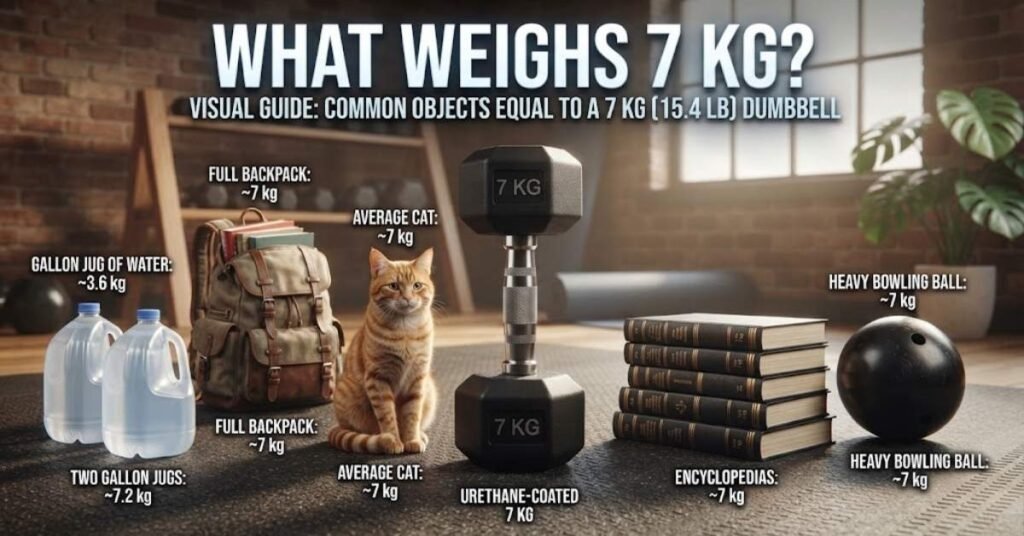
League bowlers who go for power often pick balls on the heavier end, and a bowling ball weighing around 7 kg (about 16 pounds) is common at most bowling alleys.
Bowling balls are sold by the pound, and 16 lb is usually the max most adults use. Anything heavier becomes hard to control down the lane.
Next time you’re at the alley, ask the front desk which ball is 16 pounds. Hold it for ten seconds. Congratulations, you’re now holding roughly 7 kg of solid, dense weight.
A Medium Roast Turkey
Thanksgiving math time. A medium turkey, the kind that feeds a family of six to eight, typically weighs somewhere between 6.8 kg and 7.26 kg.
That’s right in our target zone. If you’ve ever hauled a holiday turkey out of the fridge and felt your arms strain a bit, that strain was roughly 7 kg worth of bird.
Butchers usually round this size to “medium” on their labels. So next time you’re grocery store shopping before a holiday, you’ll know exactly what that weight tag translates to before you even lift the bag.
A Medium Watermelon
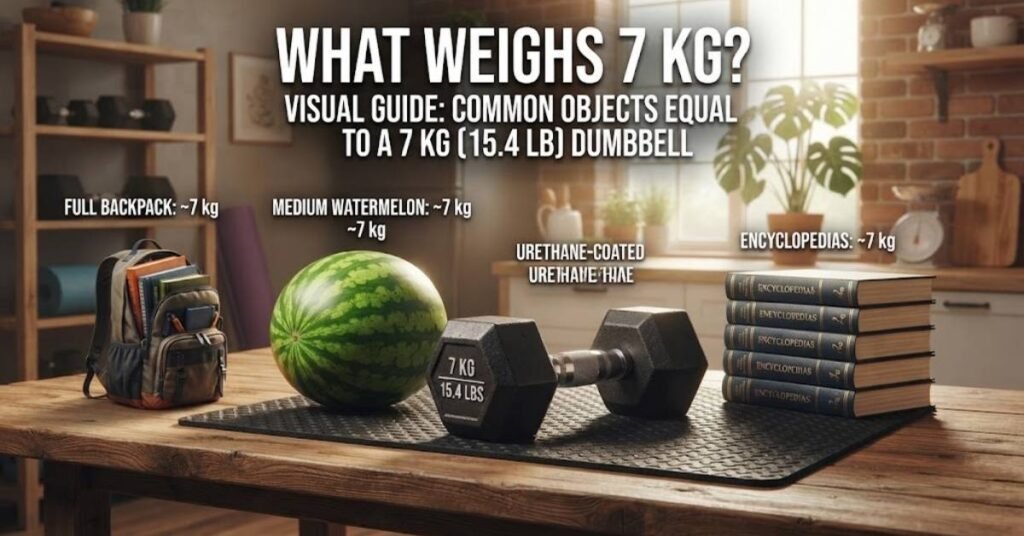
Summer’s favorite fruit also happens to be a great weight comparison tool. A medium watermelon generally weighs close to 7 kg, give or take depending on the variety.
Large ones can hit 10 kg or more, while smaller personal-size melons drop to 4 to 5 kg. But the standard, family-size watermelon you grab at the supermarket usually lands right around our number.
Here’s a fun trick: next time you’re shopping, pick up a watermelon before buying it. If your arm dips slightly and you need both hands, you’re likely holding close to 7 kg of fruit weight.
An 18-Pack of Canned Drinks
Grab an 18-pack canned drinks box from your fridge, the kind stacked with 12-ounce cans of soda or sparkling water.
Water and aluminum together push that pack close to 7 kg, especially once you factor in the cardboard packaging.
This is one of those comparisons that clicks instantly because almost everyone has carried a case of drinks from the car to the kitchen. That slight strain in your fingers from the box handle? Yep, that’s your beverage pack doing its 7 kg thing.
A Large Cast Iron Dutch Oven
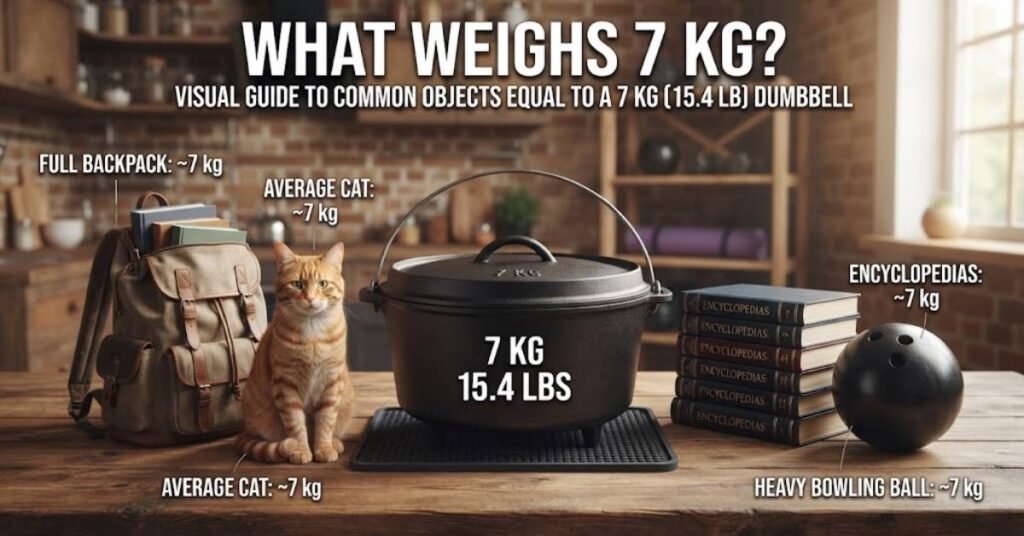
If you cook, you already know cast iron cookware is no joke when it comes to weight. A large cast iron Dutch oven, particularly the 6 quart enameled versions, often weighs close to 7 kg.
Cast iron Dutch ovens are heavy by design. That density is what gives them incredible heat retention for slow-cooked stews and roasts.
If you’ve ever tried lifting a full Dutch oven out of the oven with one hand and immediately regretted it, that’s 7 kg (plus your stew) reminding you why oven mitts and two hands exist.
A Full-Size Vacuum Cleaner
Not the lightweight cordless stick kind. We’re talking about a proper upright vacuum, the kind with a bagless vacuum canister and a strong motor.
Many full-size vacuum cleaners weigh somewhere between 6 and 8 kg, putting the average model right around our target weight.
Next time you’re pushing your vacuum up the stairs and feel that familiar strain, you’re basically doing a mini strength workout with a 7 kg household appliance.
A Packed Carry-On Suitcase
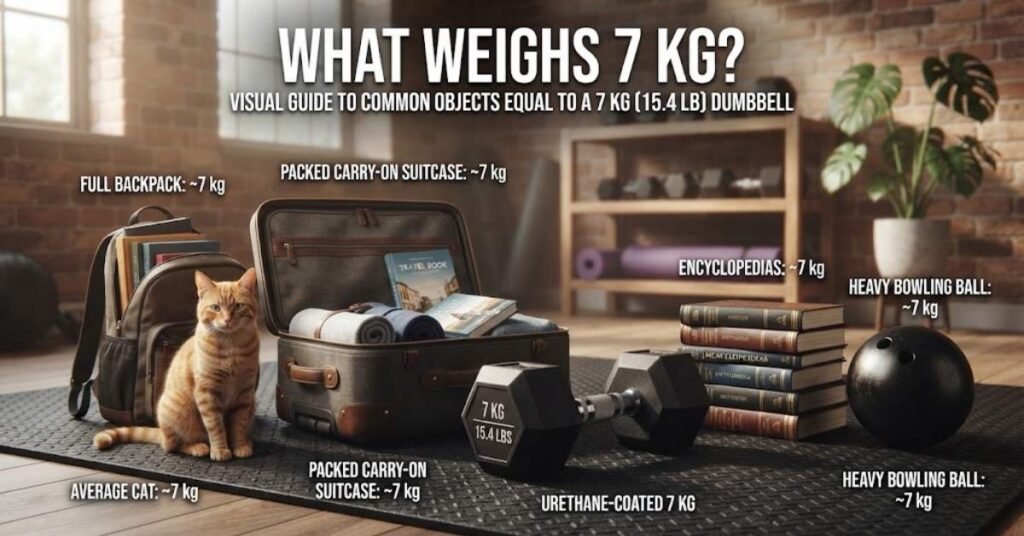
Frequent flyers know this weight intimately. Most airlines, including Emirates, Cathay Pacific, and Singapore Airlines, set their cabin baggage limit around 7 kg.
That means your fully packed carry-on suitcase, including your laptop, charger, and that extra pair of shoes you swore you wouldn’t bring, needs to stay under this number.
Gate agents at budget airlines are notoriously strict about this. If you’ve ever had to guiltily remove a jacket at the gate to avoid a gate check fee, you’ve lived through the reality of the airline weight limit firsthand. A cheap luggage scale at home saves you that embarrassment every single time.
A Full 7 kg Load of Laundry
Check your washing machine’s drum. Many standard machines list their drum capacity as 7 kg, meaning that’s how much dry clothes weight it can safely handle per cycle.
A 7 kg washing machine load usually fits around 35 shirts, or a mixed batch of towels, jeans, and everyday clothing for a small household’s weekly laundry.
Interesting twist here: wet clothes weigh noticeably more than dry ones. So that “7 kg load” reading refers to dry weight, not what you’re actually pulling out soaking wet at the end of the cycle.
A 15-Pound Bag of Dog Food
Pet owners, this one’s practically sitting in your pantry right now. A standard 15-pound bag of dog food comes in just under 7 kg, making it one of the most common pet supplies comparisons out there.
Dry dog food bags this size are popular for medium-breed dogs and usually last a few weeks depending on how much your dog eats daily.
If you’ve ever hauled one of these bags from your car trunk to the kitchen without a cart, your shoulders already know exactly what 7 kg of kibble feels like.
A Baby Around Five to Six Months
Here’s a weight reference every parent understands instantly. The average infant reaches close to 7 kg somewhere between five and six months old, though this naturally varies by baby.
Baby growth charts track this closely, and pediatricians often use it as a general milestone marker during checkups.
If you’ve ever carried a baby this age for an extended car ride or a long walk, you already know how quickly that “small” bundle turns into real arm fatigue. That’s your built-in 7 kg experience, no gym required.
A Large House Cat
Not every kitty stays dainty. Breeds like the Maine Coon, known for their size and fluffy double coats, often weigh close to 7 kg as full-grown adults.
A regular domestic cat usually sits between 3.5 and 5 kg, so a large house cat hitting 7 kg stands out noticeably on the vet’s scale.
If your cat headbutts you awake at 6 a.m. and genuinely hurts a little, there’s a decent chance you’re dealing with a cat close to this exact pet weight.
A Racing Road Bike
On the lighter end of cycling gear, a racing road bike with a carbon frame typically weighs around 6.8 kg minimum, sometimes creeping just over 7 kg depending on components.
Competition bike manufacturers shave off every possible gram, since lighter bikes mean faster climbs and quicker sprints in cycling events.
If you’ve ever picked up a proper performance bike with one hand and been shocked at how light it felt compared to your old bike at home, that surprise is the entire point. Carbon fiber engineering exists specifically to hit numbers like this.
7 kg vs Other Common Weights: A Quick Side-by-Side
Sometimes seeing 7 kg next to nearby weights helps more than any single comparison.
Here’s a weight comparison guide showing how it stacks up against numbers you’ll also run into often:
| Weight | Common Example |
| 4 kg | Women’s shot put |
| 4-5 kg | Small watermelon |
| 5 kg | Bag of sugar (bulk size) |
| 7 kg | Our target weight |
| 10 kg | Large watermelon or bag of rice |
| 55-70 kg | Average adult human |
Seeing it on a scale like this makes the common weight examples feel less abstract. 7 kg isn’t heavy in the “can’t lift it” sense, but it’s substantial enough to notice in your arms, back, or shoulders after a few minutes.
Common Mistakes People Make When Estimating 7 kg
Most people either overestimate or underestimate this weight, and it usually comes down to one thing: assumption without comparison.
People assume a “medium” sized object is automatically light. That’s how travelers end up overweight at check-in, staring at an airline restrictions sign wondering where they went wrong.
Others assume heavy-looking objects always weigh more than they actually do. A carbon fiber road bike looks solid but barely touches 7 kg, while a small bag of dog food looks harmless yet hits the same number.
The fix is simple. Use real-life weight examples like the ones above instead of guessing purely by appearance. Your eyes lie about weight far more often than a kitchen scale does.
How to Visualize 7 kg Without a Scale
Don’t have a scale handy? No problem. Try grabbing any two items from this list and holding them together.
For instance, combine a bag of sugar (roughly 1 kg) with a couple of large watermelons cut down mentally into pieces, or simply picture your washing machine’s max load weight setting.
Another trick professional movers use: pick something up, hold it at arm’s length for ten seconds, and rate the strain on a scale of one to ten. Most people rate 7 kg around a five or six, noticeable but not exhausting for short bursts.
FAQs
How heavy is 7 kg in pounds?
7 kg equals 15.43 pounds, or 15 lb 6.9 oz if you want the exact ounce breakdown.
What weighs exactly 7 kg?
A 7 kg dumbbell, a medium watermelon, a 15-pound bag of dog food, and an 18-pack of canned drinks all land close to this exact weight.
How much is 7 kg in stone?
7 kg works out to roughly 1.10 stone, which is a common unit in the UK and Ireland for body weight tracking.
Is 7 kg heavy for a carry-on suitcase?
Not really. Most airlines, including Emirates and Singapore Airlines, actually set this as their standard cabin baggage limit, so 7 kg is considered a normal, manageable travel bag weight.
How many grams are in 7 kg? 7
kilograms equals exactly 7,000 grams, since one kilogram always converts to 1,000 grams.
What household item weighs close to 7 kg?
A full-size upright vacuum cleaner or a large cast iron Dutch oven are two of the most relatable household comparisons for this weight.

James Walker is a content writer and researcher with a passion for making everyday information simple, useful, and easy to understand. He enjoys researching measurements, dimensions, size comparisons, and interesting facts and turning them into clear, engaging content for readers.
Through his work at HipeDigest, James focuses on providing informative and reader-friendly articles that combine accuracy, simplicity, and practical examples. His goal is to help readers discover useful information while making every topic enjoyable and easy to explore.
