


You hear “90 inches” and your brain kind of stalls, right?
Is that big? Small? Somewhere in between?
Here’s the short answer. 90 inches equals 7.5 feet, or 228.6 centimeters, or 2.286 meters. That’s roughly the height of a doorway with a foot to spare, or the length of a full sheet of furniture-grade fabric.
Numbers on their own don’t mean much though. You need something to hold them against. So in this guide, we’ll walk through real objects that measure close to 90 inches long, plus quick conversions you can actually use when you’re standing in a hardware store squinting at a tape measure.
Quick Conversion Guide
Let’s get the math out of the way first, because nobody wants to do division while holding a tape measure.
90 inches breaks down like this: 90 ÷ 12 gives you 7.5 feet. That’s the core of the imperial system, where every foot holds exactly 12 inches, no exceptions, no rounding tricks.
Switch over to the metric system and things get cleaner. 90 inches converts to 228.6 centimeters, which rounds to about 2.29 meters. Keep this conversion guide handy if you’re comparing inches to feet or inches to centimeters for a project.
| Measurement | Value |
| Feet | 7.5 ft |
| Centimeters | 228.6 cm |
| Meters | 2.286 m |
| Yards | 2.5 yards |
How Long Is 90 Inches?
Picture a doorway. Now add about ten inches on top of that. That’s roughly where 90 inches lands.
It’s longer than most people are tall, shorter than a standard parking space, and just about the width of a small bedroom wall. In terms of length measurement, it sits in that awkward middle zone, too big to eyeball accurately, too small to need a surveyor.
This is exactly why size comparison with everyday objects works better than staring at a number. Once you connect 90 inches to something you’ve touched or stood next to, the distance measurement finally clicks.
8 Everyday Things That Are 90 Inches Long
Here’s where the numbers turn into things you can actually picture. Each of these everyday objects hits close to the 90-inch mark, some exactly, some near enough to make the point.
Large Screen Televisions (90-Inch TV)
A 90-inch TV dominates a living room the second you turn it on. We’re talking about a screen size measured diagonally, corner to corner, not side to side.
If you’re building out a home theater, this is the kind of television screen that turns movie night into an actual event. The diagonal measurement matters here because the actual width and height come out smaller, usually around 78 inches wide and 44 inches tall.
Most rooms need at least 10 to 12 feet of viewing distance to make a screen this large comfortable on the eyes.
Queen-Size Bed Frame Length
A queen bed mattress runs 80 inches long, but the full queen-size bed frame often stretches closer to 90 inches once you add the headboard and footboard.
That extra length matters when you’re measuring a bedroom for furniture placement. Skip this step and you’ll end up with a mattress that fits but a frame that jams the door shut.
If your bedroom wall runs short, measure the total frame length first, not just the mattress size printed on the tag.
Standard Doorway Height
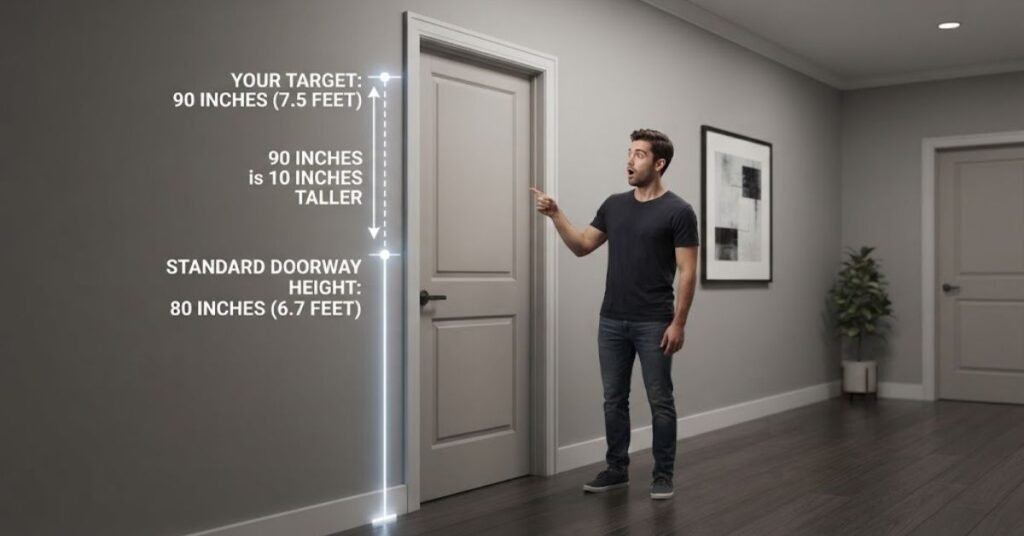
Here’s a quick correction most guides skip. A standard doorway in American homes runs about 80 inches tall, not 90.
Where 90 inches shows up is in taller interior door setups, think entryways with a transom window above the door frame, or custom builds in homes with higher ceiling height. Some grand entrances and commercial doorways stretch to 90 inches or beyond specifically for that dramatic look.
So if you’re framing a standard residential door, stick with 80. If you want that tall, modern doorway feel, 90 inches at the threshold is a common upgrade.
Professional Basketball Player Wingspan
A professional basketball player‘s wingspan, measured fingertip-to-fingertip, frequently lands right around 90 inches.
Take Kevin Durant as an example. His height is listed at 6’10”, but his wingspan stretches out to nearly 90 inches, giving him reach that a shorter, stockier player simply can’t match. Scouts obsess over this wingspan number because it predicts defensive range better than raw height ever could.
That gap between height and reach is why some NBA player evaluations focus almost entirely on arm span during draft season.
Extra-Long Shower Curtains
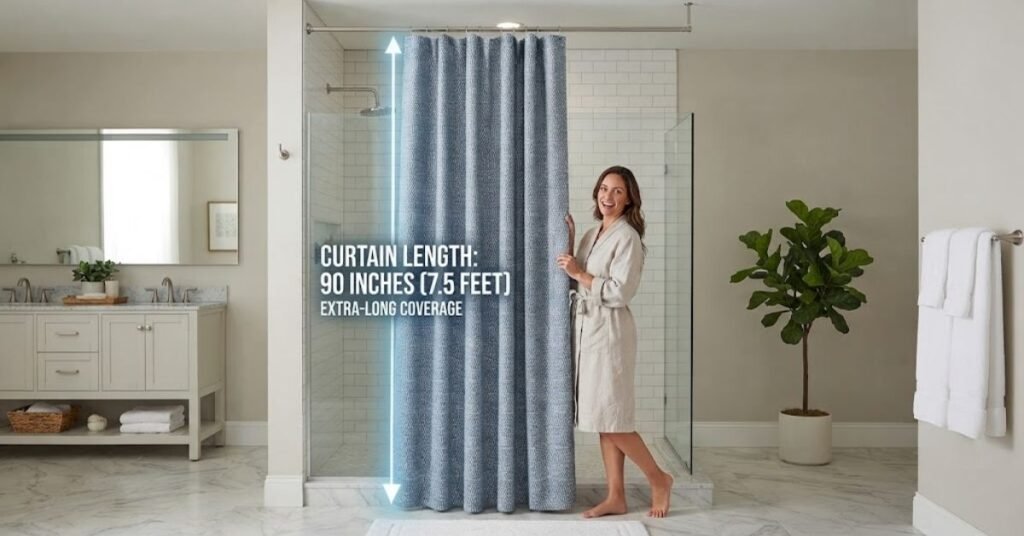
Walk into a hotel-style bathroom and you’ll often spot an extra-long shower curtain hanging closer to 90 inches.
These work best with a ceiling-mounted curtain rod, which pulls the fabric up higher and drops it further down toward the bathroom floor. That extra drop keeps water splashes contained, especially useful around a clawfoot tub where standard curtains leave gaps.
If your bathroom has taller ceilings, a standard shower curtain will look short and stubby. Go longer and the whole space feels more finished.
Large Dog Crate Dimensions
Giant breed owners know this struggle well. A large dog crate built for a Great Dane, Irish Wolfhound, or Mastiff sometimes reaches close to 90 inches in total length once you include an attached exercise pen extension.
Standard pet crate sizes top out around 54 inches for even the biggest single-unit designs. To hit that 90-inch range, owners typically connect a crate to a playpen section, giving these massive dogs enough room to stand, turn, and stretch without feeling boxed in.
Measure your dog nose to tail before buying anything. A cramped crate causes more stress than skipping one altogether.
Garden Bed or Raised Planter Length
A raised garden bed built at 90 inches long gives you a workable middle ground between a compact flower display and a sprawling vegetable garden.
This length suits small-space gardening particularly well. You get enough room for several plant rows, but the bed still fits along a fence line or against a garage wall without eating the whole yard.
Builders often frame these at 90 inches specifically because it splits evenly with standard 10-foot lumber, cutting down on wasted material during home renovation projects.
Fabric Yardage for Home Projects
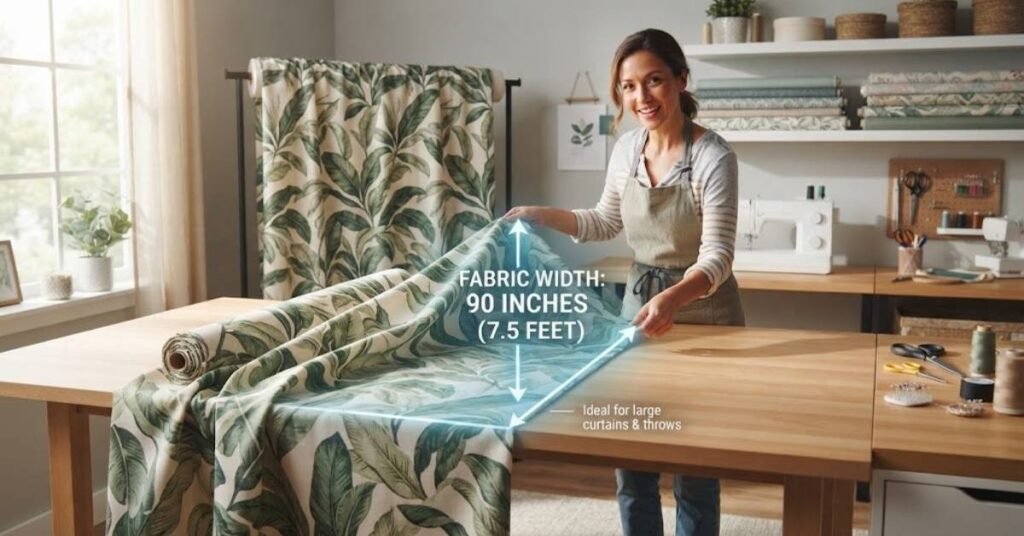
Here’s a conversion that trips people up at the fabric counter. 2.5 yards of fabric equals exactly 90 inches.
That length works well for curtains, a mid-size tablecloth, or a basic upholstery patch job. A seamstress working on home décor pieces will often round up to 2.5 yards specifically because it lines up so cleanly with the 90-inch mark, leaving minimal waste on the cutting table.
Next time you’re at the fabric store, skip the mental math. Just remember: 2.5 yards in, 90 inches out.
Uses for 90-Inch Measurements
Beyond household objects, 90 inches shows up constantly in construction and interior design work.
Construction professionals use this length when cutting lumber for door framing, deck building, or structural supports. It’s a common cut length because it minimizes waste from standard board sizes while still leaving enough material for load-bearing sections.
Interior designers lean on 90-inch dimensions for custom furniture, window treatments, and room dividers in both residential and commercial spaces. Whether it’s slipcovers, bedding, or a sewing project needing precise measurement tools, this length keeps popping up as a practical middle ground.
Why Is a Foot 12 Inches? A Quick History
Ever wonder who decided a foot should equal exactly 12 inches?
The British Imperial system traces this back to King Edward II of England, who standardized the 12-inch foot around 1324. Before that, measurements varied wildly from region to region, often based on an actual human foot, which obviously created chaos when everyone’s foot was a different size.
That standardized measurement eventually became the foundation for the entire imperial system we still use today, including how we calculate 90 inches as 7.5 feet.
Common Mistakes People Make With Length Conversions
Even simple measurement conversion work trips people up more than you’d expect.
The biggest one? Confusing 90 cm with 90 inches. These are wildly different lengths, 90 cm equals roughly 35.4 inches, while 90 inches equals 228.6 cm. Mixing these up during a DIY project or furniture shopping trip can lead to some seriously oversized mistakes.
Another common slip is forgetting that screen size on a television screen always refers to the diagonal measurement, never the width. A 90-inch TV is not 90 inches wide, and assuming otherwise leads to a very awkward furniture delivery.
How to Measure 90 Inches Without a Tape Measure
Ever needed to check a 90-inch length and realized your tape measure was nowhere in sight?
Here’s a trick that actually works. An average door stands about 80 inches tall, so 90 inches is roughly that same door height plus the length of a standard shoe box laid on its side. Two adult strides, heel to toe, also land pretty close to 90 inches for most people.
If you’ve got a yardstick lying around, 2.5 lengths of it gets you to 90 inches exactly, since one yard equals 36 inches. It’s not lab-precise, but it beats guessing when you’re mid-project and the measurement tools drawer has gone missing again.
90 Inches vs Other Common Lengths
Sometimes the easiest way to understand 90 inches is to see how it stacks up against numbers you already know.
A standard 8-foot ceiling measures 96 inches, just 6 inches taller than 90 inches. That’s a smaller gap than most people assume, which explains why a 90-inch TV or tall bookshelf can feel like it’s nearly brushing the ceiling in an average room.
Compare that to a typical car door, which opens to roughly 40 inches, less than half of 90 inches. Or a kitchen counter, sitting around 36 inches high, meaning 90 inches is basically two and a half counters stacked on top of each other. These side-by-side comparisons make 90 inches far easier to visualize than the raw number ever could on its own.
Question’s
How long is 90 inches in feet?
90 inches equals 7.5 feet. Just divide by 12, since every foot contains 12 inches.
How long is 90 inches in meters?
90 inches converts to 2.286 meters, often rounded to 2.29 meters for everyday use.
What is 90 inch drop in cm?
A 90 inch drop, common in curtain and vertical drop measurements, equals 228.6 cm.
How many years is 90 inches?
This one’s a bit of a mismatch, since inches measure length and years measure time, they don’t convert into each other. If you meant yards, though, 90 inches equals exactly 2.5 yards.
Is 90 cm 3ft?
Close, but not exact. 90 cm equals about 2.95 feet, roughly 3 feet when rounded for casual use.
How old am I if I was born in 1990?
In 2026, you’d be turning either 35 or 36, depending on whether your birthday has passed yet this year.
What is 9.8 inches in cm?
9.8 inches converts to 24.9 centimeters.
What size is 90-100 cm?
90 to 100 cm falls between roughly 35.4 inches and 39.4 inches, a range commonly used in clothing and furniture size reference charts.
Why is 1 foot 12 inches?
This traces back to King Edward II‘s 1324 standardization in England, replacing inconsistent human foot based measurements with one fixed, standardized measurement.
Conclusion
90 inches stops feeling abstract once you connect it to real things. A 90-inch TV, a queen-size bed frame, a stretch of fabric yardage, they all give that number somewhere to live in your head.
Whether you’re tackling a home improvement job, shopping for a large dog crate, or just settling an argument about screen size, you now have a solid dimensional reference to work from. Keep this conversion guide bookmarked for the next time a measurement leaves you stumped.

James Walker is a content writer and researcher with a passion for making everyday information simple, useful, and easy to understand. He enjoys researching measurements, dimensions, size comparisons, and interesting facts and turning them into clear, engaging content for readers.
Through his work at HipeDigest, James focuses on providing informative and reader-friendly articles that combine accuracy, simplicity, and practical examples. His goal is to help readers discover useful information while making every topic enjoyable and easy to explore.
