

70 inches equals 5 feet 10 inches, or about 5.83 feet.
That’s 177.8 centimeters, 1,778 millimeters, or 1.778 meters.
You’ve probably stood next to something this height today.
A standard refrigerator, a tall bookshelf, and an adult man all land right around it.
This guide shows you the real-life comparisons so you can picture it fast.
You’ll also learn tricks for measuring without a ruler and ways to use the number in room planning.
Table of Contents
- How Tall Is 70 Inches?
- What Does 70 Inches Look Like?
- Easy Ways to Measure 70 Inches Without a Ruler
- Use Your Hand
- Use Standard Printer Paper
- Compare With a Person
- Common Things That Are 70 Inches Tall
- Standard Refrigerator
- Tall Bookshelf
- Adult Man
- Floor Lamp
- Wardrobe Cabinet
- Grandfather Clock
- Large Mirror
- Home Treadmill Standing Height
- Punching Bag Setup
- Surfboard
- 70 Inches Conversion Chart at a Glance
- Why 70 Inches Matters for Room Planning
- FAQs
- Conclusion
How Tall Is 70 Inches?
Start with the basics of height measurement.
70 inches is 5 feet 10 inches, which you get by dividing 70 by 12.
That gives you 5.83 feet in decimal form.
It’s the same distance, just written two ways.
In the metric system, the inches to centimeters conversion is easy.
Multiply by 2.54 and you get 177.8 centimeters, which is also 1.778 meters.
What Does 70 Inches Look Like?
Numbers on a screen feel abstract.
So picture a standard doorway, which usually stands 80 inches tall.
A 70 inch object clears that doorway with about 10 inches to spare.
Your hand could slide flat between its top and the frame.
Now think of a typical room with ceiling height of 96 inches.
A 70 inch item leaves roughly 26 inches of empty air above it, about two rulers stacked end to end.
Easy Ways to Measure 70 Inches Without a Ruler
Say you’re in a thrift store and the tape measure is at home.
You spot a bookshelf and wonder if it fits your hallway.
You don’t need to walk away and lose the deal.
Three quick tricks give you a solid size estimation on the spot.
Each one uses something you already carry or can grab.
None of them takes more than a minute.
Use Your Hand
An adult hand length runs about 7 inches from wrist crease to fingertip.
That’s an average, so check yours against a ruler once at home.
Lay your hand flat and leapfrog it up the object.
Ten hand lengths gets you to roughly 70 inches.
Use Standard Printer Paper
Standard printer paper in A4 size is about 11.7 inches long.
Stack six sheets end to end and you land near 70 inches.
US letter paper is 11 inches long, so six sheets give you 66 inches.
Add a fourth of a seventh sheet and you’re there.
Compare With a Person
The average adult height for men in the US sits around 69 inches.
So an average male height person is just a hair shorter than our target.
Ask a friend around 5 feet 10 to stand beside the object.
If the top lines up with their head, you’ve found your 70 inches.
Common Things That Are 70 Inches Tall
Now for the fun part.
These household objects and common objects show up in homes, gyms, and beaches.
Sizes vary by brand, so treat each number as a typical range.
Always check the product listing before you buy anything.
Here’s the lineup we’ll cover, and each one gives you a visual comparison you can remember.
Standard Refrigerator

Walk into any kitchen and you’ll find this one.
A standard refrigerator often stands between 66 and 70 inches, and many French door models sit close to 70.
This appliance height matters for your kitchen layout.
Overhead cabinets need enough clearance so the door can open without a fight.
Picture a couple in a small apartment measuring for a new fridge.
They forget the hinge swing, and the door hits the wall.
Tall Bookshelf
A tall bookshelf is another easy match.
Many office bookshelf and library furniture pieces run near 70 inches, though 72 is also common.
The height gives you five or six bookshelf shelves without needing wide floor space.
That’s smart for storage boxes, binders, and heavy hardbacks.
Anchor it to the wall, though.
Tall, loaded shelves can tip, especially around kids and pets.
Adult Man

The classic example is a tall person of average build.
An adult man at 5 feet 10 inches matches 70 inches exactly.
That’s very close to the national average male height.
So when you compare human height, this is your built-in yardstick.
Furniture makers and clothing design teams use similar averages.
That’s why many doorways, shelves, and shirt lengths feel made for this height.
Floor Lamp
Look at your living room furniture and you’ll spot this one.
A floor lamp, sometimes called a standing lamp, can reach 70 inches, especially arc and torchiere styles.
As a decorative lamp, it fills a dark corner without eating table space.
The lamp height comparison to a person is handy, since the shade sits near eye level or above.
If you read in a chair, go a bit shorter.
Light that hits the page from over your shoulder beats glare in your eyes.
Wardrobe Cabinet
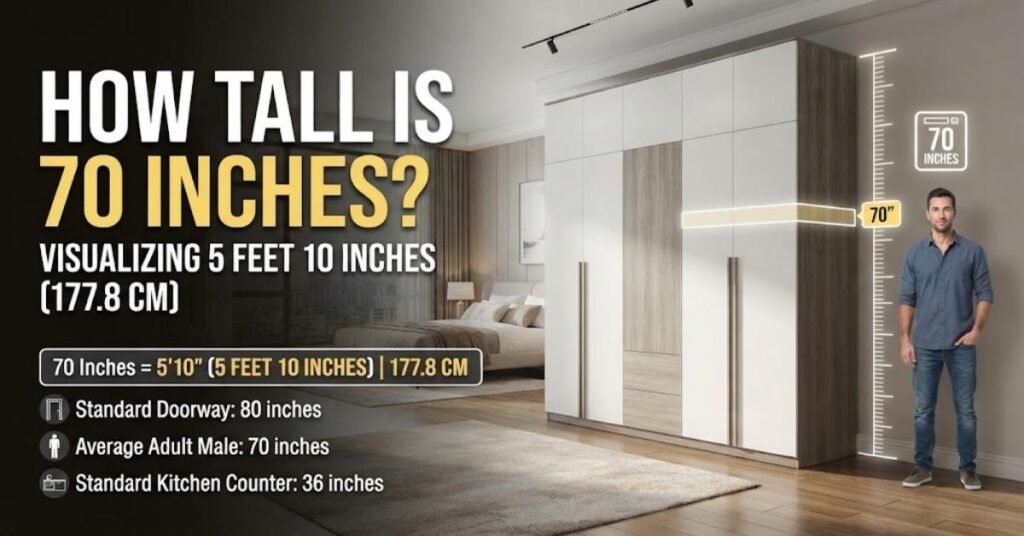
A wardrobe cabinet is a bedroom furniture staple.
Compact versions hit 70 inches, though many models climb higher.
Inside you’ll find hanging space, plus shelves and drawers for clothes storage.
Check the rod height if you own long coats or dresses.
Here’s a common story.
Someone buys a stylish wardrobe online, then learns their winter coat drags on the floor.
Grandfather Clock
This traditional clock is a true decorative centerpiece.
Most grandfather clock styles run 72 to 84 inches, so 70 sits at the short end.
The pendulum clock design needs space for a swinging weight.
Keep it level and away from busy walkways.
Compare it to a wall clock or table clock, which barely takes up floor.
The tall version brings presence and a slow, steady tick.
Large Mirror
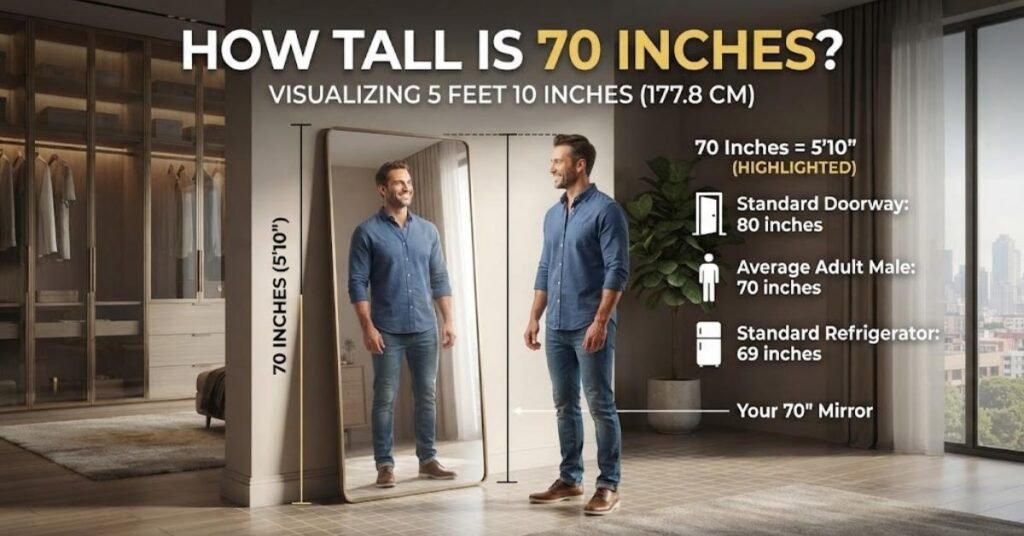
A full-length mirror, also called a standing mirror, often measures 60 to 70 inches.
At 70 inches, most adults see themselves from head to toe.
It’s a favorite for a dressing room mirror setup.
Lean it against the wall, or mount it on the back of a door.
The mirror height comparison is simple.
It’s about as tall as the person looking into it.
Home Treadmill Standing Height
Here the number works a little differently.
A home treadmill with its console usually stands shorter than 70 inches, but your body on the running surface does not.
The deck sits several inches off the floor.
A 70 inch runner may reach around 78 inches, and running bounce adds more.
That’s why ceiling clearance for treadmill use matters.
A common rule of thumb is about 12 inches of headroom above the tallest user.
Check your basement or spare room before you order.
Low ceilings, ducts, and light fixtures ruin a good home gym plan fast.
Punching Bag Setup
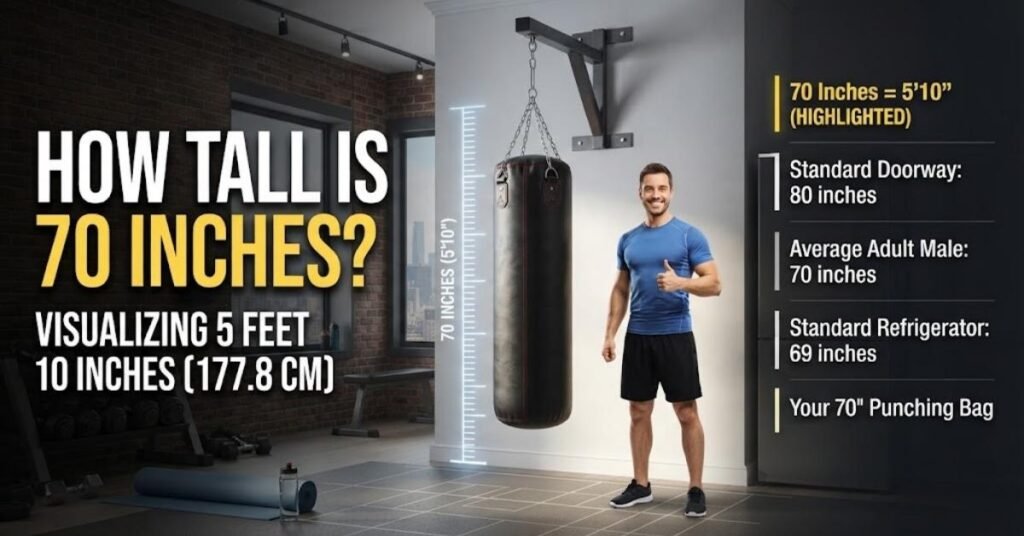
A punching bag setup gets close to 70 inches too.
Many freestanding heavy bag models land around 65 to 70 inches, though listings vary.
This piece of boxing equipment is great for boxing training and fitness training.
Leave space on all sides so you can move and swing freely.
For a hanging bag, measure from ceiling to floor first.
Then subtract the bag length and chain so it swings at a useful height.
Surfboard
Let’s head to the beach.
A surfboard around 5 feet 10 inches is a popular shortboard length, which makes it a 70 inches match.
This surfboard length suits many riders in wave conditions that are fast and punchy.
Bigger boards float better, while shorter ones turn quicker.
Beginners often pick longer boards for stability.
Your weight and skill matter more than the number alone.
70 Inches Conversion Chart at a Glance
Sometimes a conversion chart saves the day.
Here’s a quick measurement conversion table for 70 inches.
| Unit | Value |
|---|---|
| Inches | 70 |
| Feet | 5.83 |
| Feet and inches | 5 feet 10 inches |
| Centimeters | 177.8 |
| Millimeters | 1,778 |
| Meters | 1.778 |
Use it for inches to feet conversion, inches to centimeters conversion, and inches to meters conversion.
Screenshot it and keep it on your phone.
For a height scale, think small and big.
A 12 inches ruler, 15 inches laptop, 20 inches carry-on, 40 inches kitchen counter zone, 60 inches (5 feet), and 65 inches are all shorter steps toward 70.
Meanwhile, 100 feet is about 17 times taller.
Why 70 Inches Matters for Room Planning
Space planning starts with honest numbers.
Knowing object dimensions keeps you from buying a piece that won’t fit.
Measure your hallway, entry area, and living room first.
Then check the wall spacing and the ceiling space above each item.
A quick checklist helps:
- Measure the doorway before you shop
- Check ceiling clearance for tall pieces
- Allow room for doors, drawers, and swing paths
- Mark the floor with tape to preview furniture placement
This works in a small apartment or a big office.
Good interior design begins with real physical dimensions, not guesses.
FAQs
How tall is 70 inches in feet?
70 inches is 5 feet 10 inches.
In decimal form, that’s 5.83 feet.
How tall is 70 inches in centimeters?
70 inches in centimeters equals 177.8 cm.
It’s also 1,778 millimeters or 1.778 meters.
What does 70 inches look like?
Think of an adult man of average height.
A standard refrigerator or tall bookshelf gives you a similar real-life comparison.
Is 70 inches considered tall?
For a person, it’s just above the US average for men.
For furniture, it’s a fairly standard tall size, not extreme.
How can I estimate 70 inches without a ruler?
Try ten hand lengths, or stack six sheets of A4 paper.
You can also stand a person of about 5 feet 10 next to it.
Conclusion
70 inches isn’t a mystery once you tie it to daily things.
It’s 5 feet 10 inches, 177.8 centimeters, and about the height of a fridge, a mirror, or you.
Next time you shop for furniture or plan a home gym, use these comparisons.
They’ll save you returns, back strain, and awkward doorway moments.
Which object surprised you most on this list?
Drop your answer in the comments, and share this with a friend who’s about to measure a room.

James Walker is a content writer and researcher with a passion for making everyday information simple, useful, and easy to understand. He enjoys researching measurements, dimensions, size comparisons, and interesting facts and turning them into clear, engaging content for readers.
Through his work at HipeDigest, James focuses on providing informative and reader-friendly articles that combine accuracy, simplicity, and practical examples. His goal is to help readers discover useful information while making every topic enjoyable and easy to explore.
